Math Properties Real Numbers Chart Easy 8th Grade Math Real Number Problems
Real Numbers
Any number that can be found in the real world is a real number. We find numbers everywhere around us. Natural numbers are used for counting objects, rational numbers are used for representing fractions, irrational numbers are used for calculating the square root of a number, integers for measuring temperature, and so on. These different types of numbers make a collection of real numbers. In this lesson, we will learn all about real numbers and their important properties.
| 1. | What are Real Numbers? |
| 2. | Symbol of Real Numbers |
| 3. | Properties of Real Numbers |
| 4. | FAQs on Real Numbers |
What are Real Numbers?
Any number that we can think of, except complex numbers, is a real number. The set of real numbers, which is denoted by R, is the union of the set of rational numbers (Q) and the set of irrational numbers ( \(\overline{Q}\)). So, we can write the set of real numbers as, R = Q ∪ \(\overline{Q}\). This indicates that real numbers include natural numbers, whole numbers, integers, rational numbers, and irrational numbers. For example, 3, 0, 1.5, 3/2, √5, and so on are real numbers.
Definition of Real Numbers
Real numbers include rational numbers like positive and negative integers, fractions, and irrational numbers. Now, which numbers are not real numbers? The numbers that are neither rational nor irrational are non-real numbers, like, √-1, 2 + 3i, and -i. These numbers include the set of complex numbers, C.
Observe the following table to understand this better. The table shows the sets of numbers that come under real numbers.
| Number set | Is it a part of the set of real numbers? |
|---|---|
| Natural Numbers | ✅ |
| Whole Numbers | ✅ |
| Integers | ✅ |
| Rational Numbers | ✅ |
| Irrational Numbers | ✅ |
| Complex Numbers | ❌ |
Types of Real Numbers
We know that real numbers include rational numbers and irrational numbers. Thus, there does not exist any real number that is neither rational nor irrational. It simply means that if we pick up any number from R, it is either rational or irrational.
Rational Numbers
Any number which can be defined in the form of a fraction p/q is called a rational number. The numerator in the fraction is represented as 'p' and the denominator as 'q', where 'q' is not equal to zero. A rational number can be a natural number, a whole number, a decimal, or an integer. For example, 1/2, -2/3, 0.5, 0.333 are rational numbers.
Irrational Numbers
Irrational numbers are the set of real numbers that cannot be expressed in the form of a fraction p/q where 'p' and 'q' are integers and the denominator 'q' is not equal to zero (q≠0.). For example, π (pi) is an irrational number. π = 3.14159265...In this case, the decimal value never ends at any point. Therefore, numbers like √2, -√7, and so on are irrational numbers.
Symbol of Real Numbers
Real numbers are represented by the symbol R. Here is a list of the symbols of the other types of numbers.
- N - Natural numbers
- W - Whole numbers
- Z - Integers
- Q - Rational numbers
- \(\overline{Q}\) - Irrational numbers
Subsets of Real Numbers
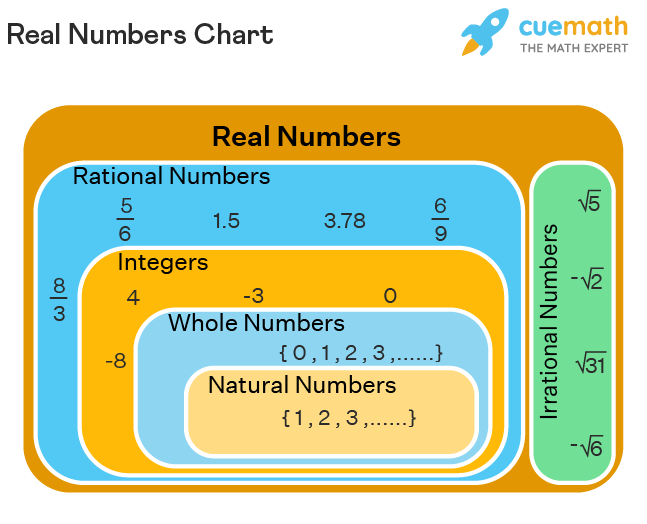
All numbers except complex numbers are real numbers. Therefore, real numbers have the following five subsets:
- Natural numbers: All positive counting numbers make the set of natural numbers, N = {1, 2, 3, ...}
- Whole numbers: The set of natural numbers along with 0 represents the set of whole numbers. W = {0, 1, 2, 3, ..}
- Integers: All positive counting numbers, negative numbers, and zero make up the set of integers. Z = {..., -3, -2, -1, 0, 1, 2, 3, ...}
- Rational numbers: Numbers that can be written in the form of a fraction p/q, where 'p' and 'q' are integers and 'q' is not equal to zero are rational numbers. Q = {-3, 0, -6, 5/6, 3.23}
- Irrational numbers: The numbers that are square roots of positive rational numbers, cube roots of rational numbers, etc., such as √2, come under the set of irrational numbers. ( \(\overline{Q}\)) = {√2, -√6}
Among these sets, the sets N, W, and Z are the subsets of Q. The following figure shows the chart of real numbers that shows the relationship between all the numbers mentioned above.
Properties of Real Numbers
Just like the set of natural numbers and integers, the set of real numbers also satisfies the closure property, the associative property, the commutative property, and the distributive property. The important properties of real numbers are mentioned below.
- Closure Property: The closure property states that the sum and product of two real numbers is always a real number. The closure property of R is stated as follows: If a, b ∈ R, a + b ∈ R and ab ∈ R
- Associative Property: The sum or product of any three real numbers remains the same even when the grouping of numbers is changed. The associative property of R is stated as follows: If a,b,c ∈ R, a + (b + c) = (a + b) + c and a × (b × c) = (a × b) × c
- Commutative Property: The sum and the product of two real numbers remain the same even after interchanging the order of the numbers. The commutative property of R is stated as follows: If a, b ∈ R, a + b = b + a and a × b = b × a
- Distributive Property: Real numbers satisfy the distributive property. The distributive property of multiplication over addition is, a × (b + c) = (a × b) + (a × c) and the distributive property of multiplication over subtraction is a × (b - c) = (a × b) - (a × c)
Real Numbers on Number Line
A number line helps us to display numbers by representing them by a unique point on the line. Every point on the number line shows a unique real number. Note the following steps to represent real numbers on a number line:
- Step 1: Draw a horizontal line with arrows on both ends and mark the number 0 in the middle. The number 0 is called the origin.
- Step 2: Mark an equal length on both sides of the origin and label it with a definite scale.
- Step 3: It should be noted that the positive numbers lie on the right side of the origin and the negative numbers lie on the left side of the origin.
Observe the numbers highlighted on the number line. It shows real numbers like -5/2, 0, 3/2, and 2.

Difference Between Real Numbers and Integers
The main difference between real numbers and integers is that real numbers include integers. In other words, integers come under the category of real numbers. Let us understand the difference between real numbers and integers with the help of the following table.
| Real Numbers | Integers |
|---|---|
| Real numbers include rational numbers, irrational numbers, whole numbers, and natural numbers. | Integers include negative numbers, positive numbers, and zero. |
| Examples of Real numbers: 1/2, -2/3, 0.5, √2 | Examples of Integers: -4, -3, 0, 1, 2 |
| The symbol that is used to denote real numbers is R. | The symbol that is used to denote integers is Z. |
| Every point on the number line shows a unique real number. | Only whole numbers and negative numbers on a number line denote integers. |
| Decimal and fractions are considered to be real numbers. | Integers do not include decimals and fractions. |
Important Tips on Real Numbers
- Every irrational number is a real number.
- Every rational number is a real number.
- All numbers except complex numbers are real numbers.
☛ Related Articles
- Prime Numbers
- Composite Numbers
- Odd Numbers
- Irrational Numbers
- Counting Numbers
- Cardinal Numbers
- Even and Odd Numbers
- Sum of Even Numbers
- Even Numbers 1 to 100
- Even Numbers 1 to 1000
- Odd and Even Numbers Worksheets
- Rational Numbers
- Natural Numbers
- Decimal Representation of Irrational numbers
- Complex Conjugate
Real Numbers Examples
go to slidego to slidego to slide

Have questions on basic mathematical concepts?
Become a problem-solving champ using logic, not rules. Learn the why behind math with our certified experts
Book a Free Trial Class
Practice Questions on Real Numbers
go to slidego to slide
FAQs on Real Numbers
What are Real Numbers in Math?
Real numbers include rational numbers like positive and negative integers, fractions, and irrational numbers. In other words, any number that we can think of, except complex numbers, is a real number. For example, 3, 0, 1.5, 3/2, √5, and so on are real numbers.
What are the Properties of Real Numbers?
The set of real numbers satisfies the closure property, the associative property, the commutative property, and the distributive property.
-
Closure Property: The sum and product of two real numbers is always a real number. The closure property of R is stated as follows: If a, b ∈ R, a + b ∈ R and ab ∈ R
-
Associative Property: The sum or product of any three real numbers remains the same even when the grouping of numbers is changed. The associative property of R is stated as follows: If a,b,c ∈ R, a + (b + c) = (a + b) + c and a × (b × c) = (a × b) × c
-
Commutative Property: The sum and the product of two real numbers remain the same even after interchanging the order of the numbers. The commutative property of R is stated as follows: If a, b ∈ R, a + b = b + a and a × b = b × a
- Distributive Property: The distributive property of multiplication over addition is a × (b + c) = (a × b) + (a × c) and the distributive property of multiplication over subtraction is a × (b - c) = (a × b) - (a × c)
What are the Subsets of Real Numbers?
Real numbers have the following five subsets:
- Natural numbers: N = {1, 2, 3, ...}
- Whole numbers: W = {0, 1, 2, 3, ..}
- Integers: Z = {..., -3, -2, -1, 0, 1, 2, 3, ...}
- Rational numbers: Q = {-3, 0, -6, 5/6, 3.23}
- Irrational numbers: ( \(\overline{Q}\)) = {√2, -√6}
What are Non Real Numbers?
Complex numbers, like √-1, are not real numbers. In other words, the numbers that are neither rational nor irrational, are non-real numbers.
How to Classify Real Numbers?
Real numbers can be classified into two types, rational numbers and irrational numbers. A rational number includes positive and negative integers, fractions, like, -2, 0, -4, 2/6, 4.51, whereas, irrational numbers include the square roots of rational numbers, cube roots of rational numbers, etc., such as √2, -√8
How to Represent Real Numbers on Number Line?
Real numbers can be represented on a number line by following the steps given below:
- Draw a horizontal line with arrows on both ends and mark the number 0 in the middle. The number 0 is called the origin.
- Mark an equal length on both sides of the origin and label it with a definite scale.
- Remember that the positive numbers lie on the right side of the origin and the negative numbers lie on the left side of the origin.
Is the Square Root of a Negative Number a Real Number?
No, the square root of a negative number is not a real number. For example, √-2 is not a real number. However, if the number inside the √ symbol is positive, then it will be a real number.
Is 0 a Real Number?
Yes, 0 is a real number because it belongs to the set of whole numbers and the set of whole numbers is a subset of real numbers.
Is 9 a Real Number?
Yes, 9 is a real number because it belongs to the set of natural numbers that comes under real numbers.
What is the Difference Between Real Numbers, Integers, Rational Numbers, and Irrational Numbers?
The main difference between real numbers and the other given numbers is that real numbers include rational numbers, irrational numbers, and integers. For example, 2, -3/4, 0.5, √2 are real numbers.
- Integers include only positive numbers, negative numbers, and zero. For example, -7,-6, 0, 3, 1 are integers.
- Rational numbers are those numbers that can be written in the form of a fraction p/q, where 'p' and 'q' are integers and 'q' is not equal to zero. For example, -3, 0, -6, 5/6, 3.23 are rational numbers.
- Irrational numbers are those numbers that are square roots of positive rational numbers, cube roots of rational numbers, etc., such as √2, - √5, and so on.
Source: https://www.cuemath.com/numbers/real-numbers/
0 Response to "Math Properties Real Numbers Chart Easy 8th Grade Math Real Number Problems"
Post a Comment